订阅Venus Lab Inner Lens,抢先获得行业最新
科研突破、新品发布和特别活动的独家内幕。
当订阅我们的品牌资讯时,您的个人信息将被妥善保护,
并严格遵守我们的隐私政策。
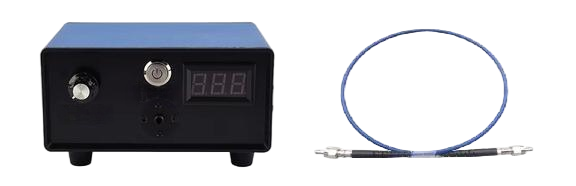
A high-stability, plug-and-play optoelectronic instrument designed for laboratories and industrial online inspection.
The Venuslab™ Series Fiber-Coupled LED Light Source is a "turnkey" optoelectronic solution engineered specifically for precision optical experiments and industrial online inspection.
This system overcomes the limitations of traditional discrete LED components—such as complex setup, difficult thermal management, and tedious optical alignment—by integrating high-performance LED chips, precision optical coupling modules, intelligent driver circuits, and an active thermal management system into a compact, ruggedized benchtop enclosure. Users require no complex optical alignment experience; simply connecting a fiber via the standard SMA905 interface delivers a monochromatic light output that is highly stable, pure, and uniform.
Optical Interface (Light Output):
Standard: The device comes with a default SMA905 interface (Universal standard for industry and laboratories), compatible with Multimode Fibers (MMF) having a Numerical Aperture (NA) of 0.22 or greater.
Customization: Optional FC/PC or ST interfaces are available upon request to match specific existing optical systems.
Front Panel Controls:
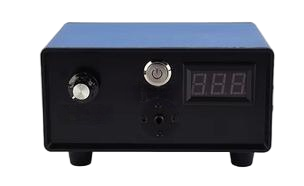
Digital Display: A 3-digit LED screen that provides a real-time readout of the current optical power output percentage (0-100).
Adjustment Knob: A multi-turn precision potentiometer allowing for fine, linear adjustment of light intensity. This ensures smooth dimming without stepping artifacts.
Mode Switch: A toggle switch to select between CW Mode (Continuous Wave / Internal Control) and EXT Mode (External Trigger / Pulse Control).
Operational Modes:
CW Mode (Continuous Wave): The LED outputs a stable, continuous beam. Intensity is controlled solely by the front panel knob.
External Trigger Mode: The LED output is controlled by an external signal (typically TTL). This allows the user to modulate the operating frequency, intensity ratio, and duty cycle via an external function generator or microcontroller, enabling synchronized stroboscopic illumination or pulse modulation.

