Join Venus Lab Inner Lens for exclusive
science and product updates.
When you sign up for our insider updates, we’ll handle your
personal information with care and in accordance with our
privacy policy.
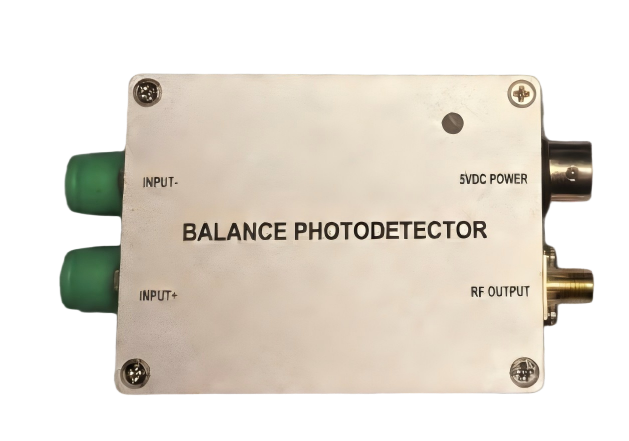
The Venuslab™ Precision Balanced Photodetector Series is a laboratory-grade optoelectronic instrument engineered specifically for weak optical signal extraction and coherent heterodyne detection. In modern photonics experiments, laser sources are often accompanied by Relative Intensity Noise (RIN), which severely limits the system's ability to detect extremely weak signals. By integrating a pair of precisely matched photodiodes (Si or InGaAs) and ultra-low noise differential amplification circuitry, this series accurately extracts the difference frequency signal from two interfering beams while effectively canceling out Common-Mode Noise.
This superior Common Mode Rejection Ratio (CMRR) enables Venuslab™ detectors to sensitively capture effective signals at the nanowatt (nW) or even picowatt (pW) level amidst strong background noise, making them the ideal demodulation core for Doppler Wind LiDAR, Optical Coherence Tomography (OCT), and Quantum Optical Transmission systems.

