Distributed Fiber Optic Sensing and Interrogation Systems
Author: Dr. K., Lead Optoelectronics Engineer
The Wall of Noise: Our Initial Struggle
When pushing the limits of our Distributed Acoustic Sensing (DAS) systems across 40-kilometer pipeline infrastructures, my team hit a hard wall. The core principle of relying on Rayleigh backscattering is elegant in theory, but in practice, the optical signals returning from the far end of the fiber were incredibly faint. We were drowning in the noise floor. Our signal-to-noise ratio (SNR) was abysmal, and the spatial resolution was nowhere near the sub-meter precision our engineering specs demanded. We spent weeks trying to apply complex digital signal processing algorithms to clean up the data, but you can't extract structural strain information from pure noise. The fundamental hardware architecture was the bottleneck.
Re-evaluating the Optical Front-End
It became clear that software couldn't fix a photon-starved environment. We needed to fundamentally change how we interrogated the fiber. The two main culprits were the pulse generation—our pulses were "leaky" and broad, causing spatial smearing—and our detection sensitivity. I started looking for components that could give us ultra-clean optical pulses and the ability to detect single-photon-level backscattering without introducing excessive dark current. This search led us to completely overhaul our optical bench with a targeted selection of VenusLab components.
The VenusLab Integration and Workflow Shift
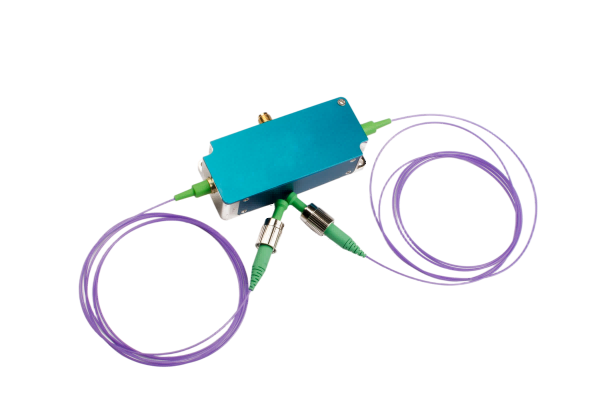
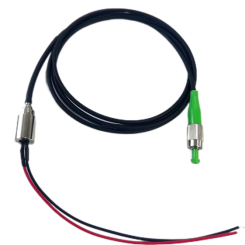
The transformation was immediate once we rebuilt the interrogation loop. First, we started with one of VenusLab's VL Fiber-Coupled Laser Sources to ensure a highly stable, narrow-linewidth seed. The real game-changer, however, was routing this continuous wave through their high-frequency Fiber-Coupled Acousto-Optic Modulator. This allowed us to carve out exceptionally narrow, high-extinction-ratio optical pulses. Clean pulses mean clean spatial domains.
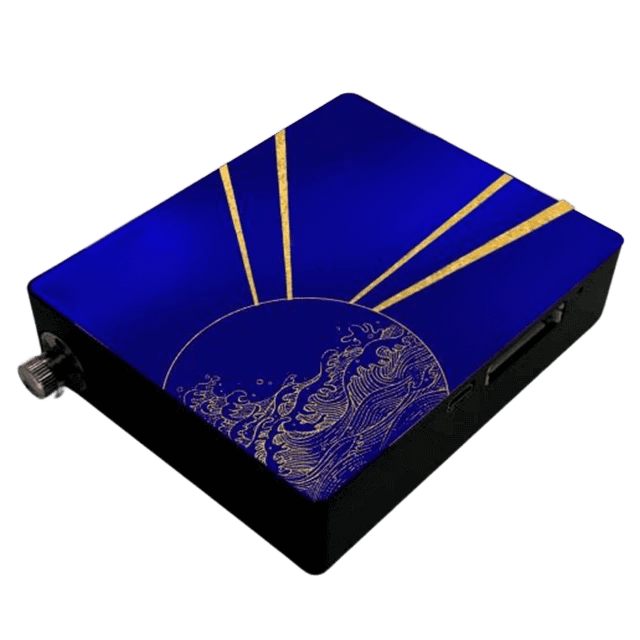
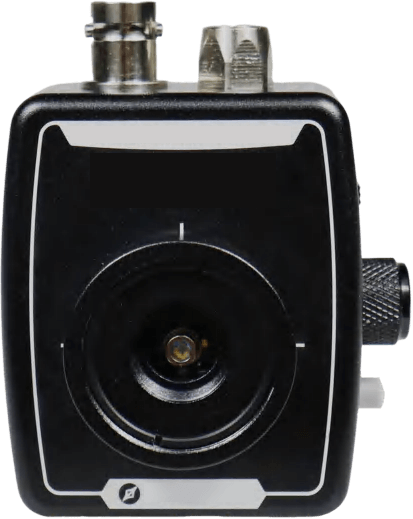
To solve the weak return signal, we replaced our standard PIN diodes with an InGaAs APD Adjustable-Gain Avalanche Photodetector. Its single-photon level sensitivity was exactly what we needed to capture the weakest backscattered signatures from the end of the 40km spool. Finally, by integrating their high-resolution Sharp 2K Spectrometer into our coherent receiver design, we could accurately resolve the minute phase and frequency shifts caused by acoustic vibrations on the fiber.
Seeing the Strain: A Clear Success
The first time we fired up the new system, the control room went completely silent. The waterfall plot on our dashboard, which used to be a fuzzy blur of static, resolved into sharp, unmistakable V-shapes mapping exactly to the acoustic taps we were making along the fiber spool. We effectively doubled our spatial resolution and pushed our sensing range well beyond our initial targets. It is incredibly satisfying as an engineer to see a theoretical design translate so perfectly into real-world performance. We finally moved from fighting our hardware to trusting our data.